That's C like in C notes, cash, Benjamins; MONEY!!!!! In other words, you can win $400 in the AT
Network's first-ever video contest; "Show Off Your AT!"
The Show Off Your AT video contest is
designed to show people the power of assistive technology and the creative ways
people with disabilities use, modify and improvise AT solutions to their
functional needs. By sharing your ideas and the solutions you've found to
challenges in you life, you can motivate and inspire others who are struggling
with challenges of their own.
Five finalists will be selected from the videos submitted.
They will be posted to the AT Network Channel on YouTube. A public vote will
determine the winners. The video that
receives the most votes will win a first place, Grand Prize of $400. The second
place video will receive a prize of $150 and third place will receive $75.
So visit http://atnet.org/video-contest
for details and the official rules. Then
whip out your Iphones, your webcams or old fashion video cameras and start
shooting! Show us how you use AT and you
just might take home a few Cs.
My husband and I are expecting a baby soon, and we had
planned to tour the UC Davis Hospital birthing suite where we will be having our baby. However, it wasn't until I read “AT on Your Due Date.”that I realized that there were some important questions I never thought
about asking the facility. I am a soon-to-be mom
with a physical disability, and I did not even think about physical access or
the types of AT I would need before and after my delivery.I assumed all hospitals would be accessible.
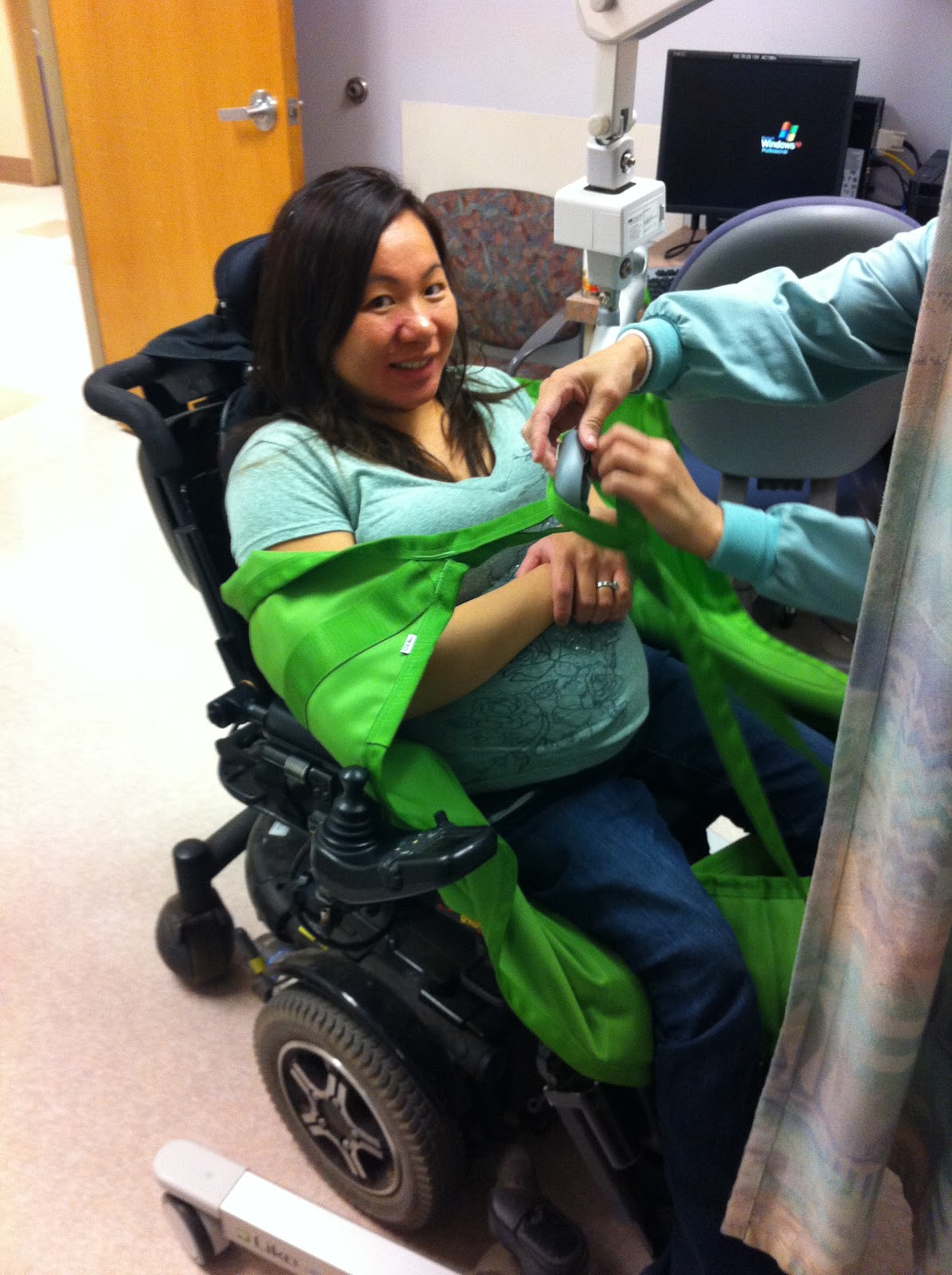
During the birthing suite tour, I looked in the bathrooms
and found that none of the rooms were wheelchair accessible nor had AT that
would work for me.All the bathrooms I
saw were tiny and had one step to get into the shower.I needed a bathroom with a roll-in-shower. Furthermore, the postpartum rooms were small and narrow,
which would not have accommodated my wheelchair.
Shannon at the doctor's office being weighed by an accessible scale
Immediately following the tour, I approached the nurse who led it and asked her if there were birthing suites with roll-in showers.She shook her head and told me no, that all the rooms are the same size and
all the bathrooms have steps. I left the birthing suite realizing I needed to be an
advocate for myself.Fortunately, I had
a work contact and colleague that also works for UC Davis and spoke to her about the the lack
of physical access in the birthing suites.
This colleague was able to forward my concerns to the department directors at the UC Davis
Hospital.The directors responded to my
concern --finding a birthing suite with more space to accommodate my
wheelchair and a roll-in shower.I then also
asked my OBGYN doctor for an accessible scale to monitor my pregnancy
weight.They are now going to provide me with the AT
I need at the hospital.
If I had not read Christina’s blog before I visited the
birthing tour, my birthing experience may have been different. I was fortunate to have the time to resolve
the physical access and AT issues before I go into labor.It is important for parents with disabilities
to network and share their perspectives on AT resources that would empower independence
and advocacy for others.
Does anyone have a story or resources for parents with disabilities to share with the AT community?
Please enter it in the comment section below.
by Christina Mills, Deputy Director of the California Foundation for Independent Living Centers
As I’ve said in earlier
blogs, my husband and I did a lot of research during our pregnancy. Part of our
research included trying out a variety of car seats to see
which ones we could both maneuver independently. It was never about the latest and greatest on
the market for us. In fact, the popular 3-in-1 car seat and stroller system was
out of the question because they are bulky, weigh too much for me and sit
too high when on a stroller. Not only was I unable to see over the stroller
with the car seat on it, but also the weight of it made it very challenging for me to
push it. We needed somethingportable, compact and, of course, safe. It took us a
few back and forth trips to the store to try out everything they had available,
but when it was all said and done we went with the Chicco KeyFit model because
it was one of the lightest available. The Keyfit system makes it super easy for
my husband and I to get the car seat both in and out of the base that it sits
in, in the car as well as the one on the Caddy Stroller. KeyFit refers to the easy audible click
and lock feature. The button you push to unlock the car seat is large, easy to
identify by its bright orange coloring, and doesn’t take a lot of hand dexterity
to release. It’s these types of details that would have been helpful to hear
about from other parents with disabilities.
The Caddy Stroller works
great for my husband and I. It’s made out of aluminum and can be folded with
one hand. It’s also very compact, but my favorite feature is the
height-adjustable handle bar. I can push it at one position; my husband can
push it at another and if needed it goes to an even higher position for someone
average height. You’re probably wondering how I push a stroller while pushing my
own wheelchair and why I don’t just carry my daughter on my lap. I’ve heard of and
seen lots of parents who use wheelchairs not use strollers to carry their
children. There are harnesses and straps that wheeler parents like me can use
to keep their child secured on their lap, but a stroller works best for my
daughter and I.
I found a picture on
Facebook of a parent who uses a wheelchair pushing a stroller. She used a
bracket attachment that went from the bottom front portion of her wheelchair
frame to the bottom bar that held the two rear wheels of the stroller. Fortunately I have many relatives that are handy and
I was able to get one made for me.
Bracket connecting stroller to wheelchair.
However, it didn’t work as well as I thought
it would. It’s much easier for me to push the stroller with one hand while
pushing my wheelchair with the other hand. I also have to point out that it’s
made shopping much easier because I can use the bottom basket of the stroller
to hold everything as where a grocery store shopping cart has always been much
less convenient and my little lap has never been able to hold a basket
sufficiently. Plus, if I run out of room
in the basket I have two “mommy hooks” on the stroller handlebar that allows me
to attach an open bag and fill it up with items too.
Throughout our pregnancy and
still today I think about all the other moms with disabilities in the world and how
useful it would be if we had an updated online AT resource guide and peer
support network made up of parents with disabilities. Don’t get me wrong - there
are a few websites floating around and they’re good, but often times I find
that they provide very limited information. That’s part of the reason why I
agreed to contribute to the AT Network Blog. AT for parents with disabilities
is critical and I hope that my family’s experiences motivate other parents with
disabilities to share their parenting journey as well.
Here’s a funny video that
my husband took of me loading my daughter from her car seat/stroller into my
car:
Earthquakes can happen at home, at work, at school, or
even on vacation.It is important that
you, your loved ones, your pets, your co-workers and millions
of others are prepared for any kind of disaster that could take place - especially an earthquake.
Last Thursday, October 18, 2012 at 10:18 AM
PST millions of people participated the 2012 Great California Shakeout's
Drop, Cover, and Hold On Drill .The purpose of the drill is to
practice how to protect yourself during an earthquake.Below is a Demonstration of Drop, Cover, and
Hold On video by the Los Angeles County Firefighters.
Is your office/home prepared
for a disaster like an earthquake? Share these resources with your loved
ones, co-workers, schools, and offices and develop your own disaster
preparedness plans.